
Stocks of companies having operations and exports to Europe were the top losers.

The rupee plunged 20 paise to close at an all-time low of 78.13 against the US dollar on Monday, as a lacklustre trend in domestic equities and stronger greenback overseas weighed on investor sentiments. Forex traders said weak Asian currencies and persistent foreign capital outflows were the other major factors that dragged the local unit down. At the interbank foreign exchange market, the local currency opened at 78.20 and witnessed an intra-day high of 78.02 and a low of 78.29 against the US dollar.

Markets closed in the red on domestic worries.
BSE benchmark Sensex plummeted over 388 points to close at 58,576.37 on Tuesday, tracking weakness in index majors Wipro, RIL and Bharti Airtel amid a weak trend in global markets. Investors also remained cautious ahead of crucial macroeconomic data announcements -- industrial production for February and inflation rate for March -- post trading hours. The Sensex declined 388.20 points or 0.66 per cent to settle at 58,576.37. During the day, the benchmark tanked 666 points or 1.12 per cent to 58,298.57.
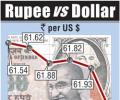
Forex dealers said weakness in local equities cast a shadow on the rupee. Dollar losing in overseas markets didn't impact the fall of the local currency, they added.

Investors' wealth tumbled over Rs 5.78 lakh crore in two days of market fall amid a weak trend in global markets after a host of central banks hiked interest rates and gave hawkish commentary. The 30-share BSE Sensex declined 461.22 points or 0.75 per cent to settle at 61,337.81 on Friday. In the previous trade, the BSE benchmark had tanked 878.88 points or 1.40 per cent to settle at 61,799.03.

Equity benchmark Sensex rallied 478 points on Monday after gains in index majors HDFC, Infosys and Kotak Bank despite a negative trend in the global markets.

The rupee tumbled 19 paise to close at a fresh lifetime low of 77.93 against the US dollar on Friday as rising crude oil prices and unabated foreign capital outflows soured sentiment. A sell-off in equity markets and stronger greenback overseas also weighed on the domestic unit, forex traders said. At the interbank foreign exchange market, the local currency opened at 77.81 and witnessed an intra-day high of 77.79 and a low of 77.93 against the US dollar.

Markets continued to fall on Monday, with the Sensex declining 94 points as investors remained cautious amid unabated selling by foreign funds and elevated crude oil prices ahead of the RBI's policy decision later this week. The 30-share BSE Sensex declined 93.91 points or 0.17 per cent to end at 55,675.32. During the day, it tanked 473.49 points or 0.84 per cent to 55,295.74.
Equity investors became poorer by over Rs 8 lakh crore in five days of market plunge. The BSE benchmark has lost 2,062.99 points or 4 per cent in five trading sessions. On Thursday, the 30-share BSE benchmark tanked 585.10 points or 1.17 per cent to close at 49,216.52. Following the bearish trend, the market capitalisation of BSE-listed companies declined by Rs 804,216.71 crore to Rs 2,01,22,436.75 crore in five days.

Investors have lost a hefty Rs 11,45,267.43 crore in two days as the domestic equity market continued to face severe drubbing amid a global selloff. The BSE benchmark Sensex plunged 1,189.73 points or 2.09 per cent to close at 55,822.01 on Monday. During the day, it tanked 1,879.06 points to 55,132.68.

Axis Bank was the top loser in the Sensex pack, tanking over 28 per cent, followed by Bajaj Finance, IndusInd Bank, ICICI Bank, Maruti and L&T. NSE Nifty nosedived 1,135.20 points or 12.98 per cent to settle at 7,610.25.

According to experts, this will have major impact on new investments by Chinese players in companies, such as Paytm, Ola, BigBasket, Byju's, Dream11, MakeMyTrip, and Swiggy, when they go for follow-up funding. Chinese investors, such as Alibaba, Tencent, and Xiaomi, are active in the Indian start-up space, and have collectively invested billions of dollars.

Demonetisation, Donald Trump's surprise victory in the US presidential elections, and the fear that US Fed may hike rates in the upcoming policy review in December have dented market sentiments, report Puneet Wadhwa & Deepak Korgaonkar.

Sebi's move to curb volatility didn't work for the market as rules were applicable for both long and short positions which makes difficult new long positions while short positions caused more price damage due to lack of liquidity.

The Sensex ended 229 points down at 27,602 and the Nifty ended down 63 points at 8,293.
After turning net buyers for the fifth straight month till June, foreign portfolio investors (FPIs) withdrew a net of Rs 11,743 crore ($1.7 billion) in July. This was their highest outflow since October 2018.

'...to bring the Global South and others to the negotiating table on the basis of Gandhi's non-violence so that we can leave a safer world for our children.'

Investors in international funds should have a horizon of more than five years. Not only will this help them overcome equity and currency volatility, it will also help them enjoy better tax treatment, says Sanjay Kumar Singh.

The combined market-cap of all listed Adani group firms has plunged nearly Rs 7.11 trillion since January 24 when the Hindenburg report was made public.

Total market capitalisation of BSE listed firms stood at Rs 101.49 lakh crore on March 31.

Maruti was the top loser in the Sensex pack, shedding around 3 per cent, followed by L&T, IndusInd Bank, Axis Bank, ONGC, Reliance Industries, Asian Paints and HDFC. On the other hand, HCL Tech, TCS, Sun Pharma and Tech Mahindra were among the gainers.

The IOC share sale is the fourth disinvestment this fiscal but the biggest in 2015-16 so far.

SBI was the top laggard in the Sensex pack, dropping over 5 per cent, followed by Sun Pharma, Maruti, Bajaj Finance, Tata Steel, Axis Bank and ICICI Bank. On the other hand, IndusInd Bank, Hero MotoCorp and PowerGrid were among the gainers.

Tata Steel was the top loser in the Sensex pack, sinking over 5 per cent, followed by SBI, IndusInd Bank, Bajaj Finance, HDFC Bank and NTPC. NSE Nifty tanked 371 points to 16,614.20.

From the 30-share pack, Sun Pharma, TCS, Tech Mahindra, NTPC, Wipro, UltraTech Cement, Dr Reddy's Laboratories and Infosys were the major gainers, jumping up to 3.99 per cent. In contrast, Tata Steel, Nestle, Titan Company, PowerGrid, Reliance Industries Limited and State Bank of India were among the laggards.

The Finance Ministry's Economic Survey had projected a growth rate of 7-7.75 per cent.

'This is a good time to restructure your portfolio because the sectors and stocks that performed in the last bull market may not perform as much now.'

At the pre-Budget meeting at Niti Aayog, Modi called for a focussed effort from all stakeholders in order to achieve the target of $5 trillion economy. The participants urged the government to focus on credit expansion, exports growth, governance of PSBs, increasing consumption and job creation.

After rallying 543 points in the morning session and touching the 40,000-mark, the BSE Sensex surrendered all gains to close at 38,628.29, showing a loss of 839.02 points or 2.13 per cent. Similarly, the NSE Nifty tanked 260.10 points or 2.23 per cent to end at 11,387.50.
Bajaj Finance was the top loser in the Sensex pack, tanking over 10 per cent, followed by Axis Bank, Maruti, M&M, Tech Mahindra and ONGC. The gainers included ITC, Bharti Airtel, Kotak Bank and Hero MotoCorp.
Tech Mahindra was the top laggard in the Sensex pack, cracking over 5 per cent, followed by Infosys, HDFC, IndusInd Bank, Reliance Industries and NTPC. On the other hand, Hero MotoCorp, L&T, Maruti, UltraTech Cement and Sun Pharma led the gainers' chart.

Exposure to debt funds and gold is essential even if current returns from these asset classes are low, suggests Sanjay Kumar Singh.

While a coordinated aggressive monetary easing from the central banks is most likely to offer some respite in the near-term, it is unlikely to improve the sentiments.

The combination of sanctions, and low fuel prices is really hurting the Putin regime.

Colombo seems to be veering to the middle path between China and the US on global matters, but in regional matters of strategic security, it is increasingly identifying with India, points out N Sathiya Moorthy.

Analysts suggest investors remain in a wait-and-watch mode and not jump in to buy stocks across-the-board.
Just a few weeks ago, Communications Minister Ashwini Vaishnaw did some tough talking with the senior managers of Bharat Sanchar Nigam Ltd, the ailing state-owned telecom service provider. The message was clear: They had to perform, quit by taking the voluntary retirement package or be compulsorily retired from service. The terse message from an otherwise polite and soft-spoken minister came just days after he announced a second and bigger package of Rs 1.64 trillion as part of a four-year turnaround plan for BSNL.
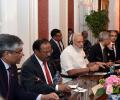
Prime Minister Narendra Modi met representatives of several prominent American think-tanks on Monday -- his last engagement of the day -- to understand how they look at global trends and challenges and what India and the US can do together for the world.

Dollar gains against other currencies overseas amid euro zone debt concerns also put pressure on the Indian rupee.
